Picasso Creative Writing Method: To execute, communicate and share our "CREATIVE MISSION" as set out below - *Comprehensive Creative Creativity with curated articles, posts, blogs and studies from around the world that support or relate to this rich inter-disciplinary approach to sustainable life-long creations and imagination.
Our "Creative Mission" is to foster a rich, interdisciplinary dialogue that will convey and forge new tools and applications for creative, critical and philosophical thinking; engaging the world in the process. Through workshops, tutorials and social media platforms we also strive to entertain, educate and empower people - from individuals, to businesses, governments or not-for-profit groups; we aim to guide them in building a base of constructive ideas, skills and a Brain Fit paradigm - thereby setting the stage for a sustainable, healthy, and creative approach and lifestyle . These synthesized strategic "Critical Success Factors" - can then give rise to applied long-term life or business - Operating Living Advantages and Benefits.
And, at the same time, we encourage Charlie Monger's key attitude and belief - for and with all of whom we reach - " develop into a lifelong self-learner through voracious reading; cultivate curiosity and strive to become a little wiser (and more grateful)* everyday."
* CCC Added - Editor
Search This Blog
Showing posts with label #Imagine #Inspire #Motivate #Empower #Success #Ideas #Learn #Listen #Laugh. Show all posts
Showing posts with label #Imagine #Inspire #Motivate #Empower #Success #Ideas #Learn #Listen #Laugh. Show all posts
My parents thought I would make a good doctor or engineer. I excelled at science and math, after all. Instead I chose to pursue journalism, even though it seemed better suited for a “creative person” than for me. I had a passion for writing but not necessarily a flair, and my early efforts were not pretty. Fortunately, as this special edition shows, creativity is not just something you're born with. Most of us have more of it than we realize.
Some people, of course, have a creative edge from an early age. In “Predicting Artistic Brilliance,” Jennifer E. Drake and Ellen Winner write about a two-year-old who would work meticulously for days on a single drawing and about another child who drew astonishingly realistic dinosaurs by age six. These children have what the authors call “a rage to master.”
What makes some people more creative than others? In “The Unleashed Mind,” Shelley Carson writes that genetic variations may make some people's brain more open to thoughts, sensations and behaviors that don't make it past the average person's mental filters. These same variations may also explain why many highly creative people seem eccentric at times—or even suffer from mental illness.
The Science of Creativity - Talks at GOOGLE
Despite these genetic variations, “nurture may still account for the lion's share of genius,” writes Dean Keith Simonton in “The Science of Genius.” Practice, training and exposure to unfamiliar ideas and experiences play essential roles in shaping creativity. Even something as simple as living in a big city promotes creativity because close contact with other humans breeds new ideas, explains Edward Glaeser in “Engines of Innovation.”
Dreams and imaginative play can also nurture creativity. Dreaming may allow ideas to incubate during sleep, leading to inspiration during waking hours, writes Deirdre Barrett in “Answers while You Sleep.” Daydreaming can likewise fire up neurons that give you access to ideas and solutions hovering below the surface of your consciousness, as Josie Glausiusz writes in “Living in an Imaginary World.” Stimulating the brain with a weak electric current to make the left hemisphere less dominant may even boost creative thinking, according to Allan W. Snyder et al. in “Switching on Creativity.” A panel of experts reveals other powerful techniques for cultivating originality in “Let Your Creativity Soar.”
As it turns out, creativity is just as important in medicine and engineering as it is in journalism. In “Your Fertile Brain at Work,” Evangelia G. Chrysikou explains how innovation can elevate the careers of chefs, university presidents, psychotherapists, police detectives, teachers, engineers, architects, attorneys and surgeons. We hope this special issue will help you unleash your own creative self.
Disclaimer: The facts and opinions expressed within this article are the personal opinions of the author. Picasso Creative Writing does not assume any responsibility or liability for the accuracy, completeness, suitability, or validity of any information in this article.
Students often go to visit Warren Buffett. And when they do, he often plays a little game on them.
He asks each student to pick a classmate. Not just any classmate, but the classmate you would choose if you could have 10% of their earnings for the rest of their life. Which classmate would you pick and why?
“Are you going to pick the one with the highest IQ?” asks Buffett. “Are you going to pick the guy who can throw a football the farthest? The one with the highest grades? What qualities will cause you to pick them?”
Then he changes things up again. Who would you think least likely to succeed? Why?
He asks the students to take out a sheet of paper and list the positive attributes on the left and the negative ones on the right.
Inevitably, the most useful qualities have nothing to do with IQ, grades, or family connections. People pick based on generosity, kindness, and integrity.
He then asks the students which of the qualities they are incapable of having and which they are incapable of stopping?
“To Buffett, the answer is none,” writes Michael Eisner in Working Together: Why Great Partnerships Succeed. “These qualities are choices people make. People decide whether or not to be generous, they decide whether or not to take credit for things they didn’t do, whether or not to keep score in life, whether or not to be envious.”
It’s quite simple in the end. Develop qualities from the left and try to stop doing the ones on the right.
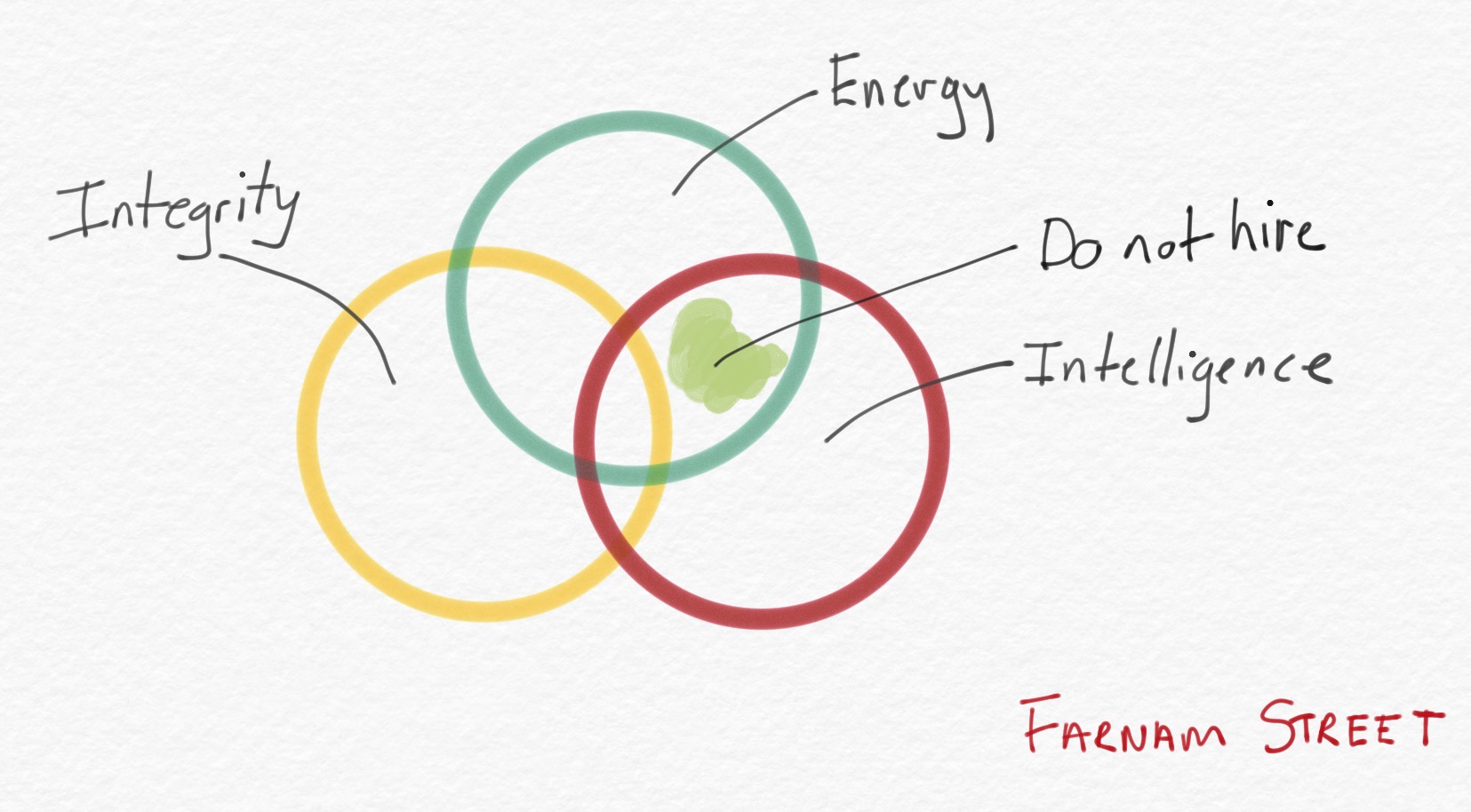
“You’re looking for three things, generally, in a person,” says Buffett. “Intelligence, energy, and integrity. And if they don’t have the last one, don’t even bother with the first two. I tell them, ‘Everyone here has the intelligence and energy—you wouldn’t be here otherwise. But the integrity is up to you. You weren’t born with it, you can’t learn it in school.”
Buffett and Munger were fortunate. They were both smart and worked hard to improve that advantage. The integrity, however, they chose.
“You decide to be dishonest, stingy, uncharitable, egotistical, all the things people don’t like in other people,” argues Warren. “They are all choices. Some people think there’s a limited little pot of admiration to go around, and anything the other guy takes out of the pot, there’s less left for you. But it’s just the opposite.”
Disclaimer: The facts and opinions expressed within this article are the personal opinions of the author. Picasso Creative Writing does not assume any responsibility or liability for the accuracy, completeness, suitability, or validity of any information in this article.
"This," says Kazumi Kayo, "is one of the reasons we Okinawans live so
long." We're in the Makishi Public Market in Naha, Okinawa's capital,
and she's just handed me what looks like a lump of scaly wood. Smooth
and tobacco coloured, tapering to a point at both. It's katsuobushi,
dried and smoked bonito tuna. To Okinawans this is catnip, a flavour
enhancer that you add to soups, the pork dishes that are an Okinawan
specialty and just about any other main-course dish. You can buy it
pre-flaked, in which case it looks like pink, feathery wood shavings,
but diligent cooks like Kayo will shave off what they need, as you would
with parmesan.
Kazumi Kayo operates Yonner Food, an experience
into the Okinawan way of life via the medium of Ryukyuan cuisine and
culture. We've spent half an hour with her trolling through the market,
admiring tuna, parrot fish, sweet potatoes, lobster, the local version
of donuts and odd bits of pork.
SECRETS OF LONGEVITY
In the kitchen of her apartment she makes us rose tea, from hibiscus
flowers which unfurl prettily in our glasses. Then it's down to business
as we prepare pork belly in stock with soya garnished with katsuobushi,
seaweed soup and a stir fry made with goya, the bitter gourd with a
pimply skin, onion, carrot, more pork, eggs and tofu.
Okinawans are famously long lived. Once past the age of 65, men can
expect to live to about 84, for women it's close to 90. Per head of
population, there are more centenarians on Okinawa than anywhere else,
five times more than in the rest of Japan, and that's a high bar. Rates
of cancer, stroke, coronary heart disease and depression are well below
the average for advanced economies yet they don't go to gyms nor do they
jog. Instead you can see elderly Okinawans working in their vegetable
gardens, practising tai chi and riding bikes.
Food is part of the
reason. It's a low-carb diet with lots of fruit, tofu, vegetables and
seaweed. Rather than seafood, the No. 1 source of protein is pork, and
not just the fatty pork belly but also pig's trotters, roasted pork ribs
and pork ears, served thinly sliced, simmered slowly and dressed in
sake vinaigrette. But is it just down to food?
LOW CARB DIET?
"Maybe it's just happiness," according to Chris Dong, my guide, a
former US Marine who met his Japanese wife when he was stationed on
Okinawa, and stayed. "Okinawans are bonding, social animals, they spend a
lot of time with family and friends, and they're incredibly
supportive."
Okinawans' longevity is not a given. Kazumi Kayo, in
her 50s, tells me hers is the first generation of Okinawans that will
not live as long as their parents. "Traditional food was also medicine,"
she says, "and it's slow food. Now people have less time so they go for
convenience foods and that means a less healthy diet and we're seeing
more and more health problems."
Okinawa is the largest of the
Ryukyu Islands, the semi-circular archipelago of over 150 islands
stretched between southern Japan and Taiwan.
In historic times the
rulers of Okinawa owed their allegiance to the Chinese emperor, not to
the bit-players in Japan. In Shuri Castle, former seat of the supreme
ruler of Okinawa, a diorama shows a new ruler being anointed by
emissaries from China. Until given the tick by China, he was a ruler in
waiting. In the early 1600s the island was invaded by samurai sent by
Japan's powerful Satsuma clan, the beginning of a slow but steady
incorporation of the
ATTITUDE AFFECTS HEALTH
Another facet of Okinawan culture that traces its origins to China is
the noble art of karate, open hand fighting. Chinese martial arts were
first introduced around 1400 and when the Satsuma samurai banned weapons
in the wake of their invasion, Okinawan karate put on a spurt.
According to popular belief it was also this ban on weaponry that gave
birth to the even more deadly martial art of kobudo, which uses farm and
fishing implements including staves, oars and the chain-linked nunchaku
to lethal effect.
Tetsuhiro Hokama is the director of the Okinawa Prefecture Karate
Museum, found on the second floor of Hokama Sensei's dojo. It's a
fascinating collection of photos, books and weaponry as well as a chance
to peek at the classes that Hokama conducts for students who come from
all over the world. Hokama's specialty is kyusho, attacking nerve
points, which allows a small opponent to paralyse a much larger one. It
also involves a severe toughening up exercise to withstand blows, also
designed to weaponise elbows, hands, feet and knees. Just watching the
pounding that goes on in the warm-up is painful.
In Naha, the Dojo
bar is tribute to the fighting arts of Okinawa operated by British-born
James Pankiewicz, a karate aficionado. It's a favourite hangout for
expats as well as the local Okinawan martial arts community and
Pankiewicz is the man to know if you've come here to work on your
karate, or just absorb the atmosphere. The Dojo Bar is just as renowned
for its range of British draught beers, wines and awomori-based drinks,
cure-alls for any martial arts related disorders. Just don't go looking
to fight.
BENEFITS OF MARTIAL ARTS
Although its people speak Japanese, go to bathhouses and arrange
their empty footwear with geometric precision, Okinawa is not Japan.
Okinawa is more chilled, less workaholic and less self conscious than
the rest of Japan. It's where Japan takes its shirt off, a subtropical
island with palm trees and flaming bougainvillea and diving on the to-do
list. The flight in to Naha Airport takes you over a mottled sea dotted
with coral reefs. Hawaiian style shirts are popular, and it was
Okinawans living in Hawaii who introduced the splashy floral patterned
shirt to the world. While Japan was historically isolationist, Okinawa
was outward looking and multicultural.
"You should see our
whales," says the man in the tourist office. "Between January and the
end of March, humpback whales spend the winter here and you can see them
leaping from the water."
Disclaimer: The facts and opinions expressed within this article are the personal opinions of the author. Picasso Creative Writing does not assume any responsibility or liability for the accuracy, completeness, suitability, or validity of any information in this article.
First published Tue May 21, 1996; substantive revision Tue Mar 10, 2015
Principia Mathematica, the landmark work in formal logic written by Alfred North Whitehead and Bertrand Russell, was first published in three volumes in 1910, 1912 and 1913. A second edition appeared in 1925 (Volume 1) and 1927 (Volumes 2 and 3). In 1962 an abbreviated issue (containing only the first 56 chapters) appeared in paperback. In 2011 a digest of the book's main definitions and theorems, originally transcribed by Russell for Rudolf Carnap, was reprinted in The Evolution of Principia Mathematica, edited by Bernard Linsky.
Written as a defense of logicism (the thesis that mathematics is in some significant sense reducible to logic), the book was instrumental in developing and popularizing modern mathematical logic. It also served as a major impetus for research in the foundations of mathematics throughout the twentieth century. Along with Aristotle's Organon and Gottlob Frege's Grundgesetze der Arithmetik, it remains one of the most influential books on logic ever written.
Logicism is the view that (some or all of) mathematics can be reduced to (formal) logic. It is often explained as a two-part thesis. First, it consists of the claim that all mathematical truths can be translated into logical truths or, in other words, that the vocabulary of mathematics constitutes a proper subset of the vocabulary of logic. Second, it consists of the claim that all mathematical proofs can be recast as logical proofs or, in other words, that the theorems of mathematics constitute a proper subset of the theorems of logic. As Russell writes, it is the logicist's goal “to show that all pure mathematics follows from purely logical premises and uses only concepts definable in logical terms” (1959, 74).
The logicist thesis appears to have been first advocated in the late seventeenth century byGottfried Leibniz. Later, the idea was defended in much greater detail by Gottlob Frege. During the critical movement of the 1820s, mathematicians such as Bernard Bolzano, Niels Abel, Louis Cauchy and Karl Weierstrass succeeded in eliminating much of the vagueness and many of the contradictions present in the mathematics of their day. By the mid- to late-1800s, William Hamilton had gone on to introduce ordered couples of reals as the first step in supplying a logical basis for the complex numbers and Karl Weierstrass, Richard Dedekindand Georg Cantor had all developed methods for founding the irrationals in terms of the rationals. Using work done by H.G. Grassmann and Richard Dedekind, Guiseppe Peano had then gone on to develop a theory of the rationals based on his now famous axioms for the natural numbers. By Frege's day, it was thus generally recognized that large parts of mathematics could be derived from a relatively small set of primitive notions.
Even so, it was not until 1879, when Frege developed the necessary logical apparatus, that logicism could finally be said to have become technically plausible. After another five years' work, Frege arrived at the definitions necessary for logicising arithmetic and during the 1890s he worked on many of the essential derivations. However, with the discovery of paradoxes such as Russell's paradox at the turn of the century, it appeared that additional resources would need to be developed if logicism were to succeed.
By 1902, both Whitehead and Russell had reached this same conclusion. Both men were in the initial stages of preparing second volumes to their earlier books on related topics: Whitehead's 1898 A Treatise on Universal Algebra and Russell's 1903 The Principles of Mathematics. Since their research overlapped considerably, they began collaborating on what would eventually become Principia Mathematica. By agreement, Russell worked primarily on the philosophical parts of the project, including the book's philosophically rich Introduction, the theory of descriptions, and the no-class theory (in which set or class terms become meaningful only when placed in well-defined contexts), all of which can still be read fruitfully even by non-specialists. The two men then collaborated on the technical derivations. As Russell writes,
As for the mathematical problems, Whitehead invented most of the notation, except in so far as it was taken over from Peano; I did most of the work concerned with series and Whitehead did most of the rest. But this only applies to first drafts. Every part was done three times over. When one of us had produced a first draft, he would send it to the other, who would usually modify it considerably. After which, the one who had made the first draft would put it into final form. There is hardly a line in all the three volumes which is not a joint product. (1959, 74)
Initially, it was thought that the project might take a year to complete. Unfortunately, after almost a decade of difficult work on the part of the two men, Cambridge University Press concluded that publishing Principia would result in an estimated loss of 600 pounds. Although the press agreed to assume half this amount and the Royal Society agreed to donate another 200 pounds, this still left a 100-pound deficit. Only by each contributing 50 pounds were the authors able to see their work through to publication (Whitehead, Russell and James, 1910).
Publication involved the enormous job of type-setting all three volumes by hand. In 1911, the printing of the second volume was interrupted when Whitehead discovered a difficulty with the symbolism. The result was the insertion (on roman numeral pages) of a long “Prefatory Statement of Symbolic Conventions” at the beginning of Volume 2.
Today there is not a major academic library anywhere in the world that does not possess a copy of this landmark publication.
Achieving Principia's main goal proved to be a challenge. Primarily at issue were the kinds of assumptions Whitehead and Russell needed to complete their project. Although Principiasucceeded in providing detailed derivations of many major theorems in finite and transfinite arithmetic, set theory, and elementary measure theory, two axioms in particular were arguably non-logical in character: the axiom of infinity and the axiom of reducibility. The axiom of infinity in effect states that there exists an infinite number of objects. Arguably it makes the kind of assumption generally thought to be empirical rather than logical in nature. The axiom of reducibility was introduced as a means of overcoming the not completely satisfactory effects of the theory of types, the mechanism Russell and Whitehead used to restrict the notion of a well-formed expression, thereby avoiding Russell's paradox. Although technically feasible, many critics concluded that the axiom was simply too ad hoc to be justified philosophically. Kanamori sums up the sentiment of many readers: “In traumatic reaction to his paradox Russell had built a complex system of orders and types only to collapse it with his Axiom of Reducibility, a fearful symmetry imposed by an artful dodger” (2009, 411). In the minds of many, the issue of whether mathematics could be reduced to logic, or whether it could be reduced only to set theory, thus remained open.
In response, Whitehead and Russell argued that both axioms were defensible on inductive grounds. As they tell us in the Introduction to the first volume of Principia,
self-evidence is never more than a part of the reason for accepting an axiom, and is never indispensable. The reason for accepting an axiom, as for accepting any other proposition, is always largely inductive, namely that many propositions which are nearly indubitable can be deduced from it, and that no equally plausible way is known by which these propositions could be true if the axiom were false, and nothing which is probably false can be deduced from it. If the axiom is apparently self-evident, that only means, practically, that it is nearly indubitable; for things have been thought to be self-evident and have yet turned out to be false. And if the axiom itself is nearly indubitable, that merely adds to the inductive evidence derived from the fact that its consequences are nearly indubitable: it does not provide new evidence of a radically different kind. Infallibility is never attainable, and therefore some element of doubt should always attach to every axiom and to all its consequences. In formal logic, the element of doubt is less than in most sciences, but it is not absent, as appears from the fact that the paradoxes followed from premisses which were not previously known to require limitations. (1910, 2nd edn 59)
Whitehead and Russell were also disappointed by the book's largely indifferent reception on the part of many working mathematicians. As Russell writes,
Both Whitehead and I were disappointed that Principia Mathematica was only viewed from a philosophical standpoint. People were interested in what was said about the contradictions and in the question whether ordinary mathematics had been validly deduced from purely logical premisses, but they were not interested in the mathematical techniques developed in the course of the work. ... Even those who were working on exactly the same subjects did not think it worth while to find out what Principia Mathematica had to say on them. I will give two illustrations: Mathematische Annalenpublished about ten years after the publication of Principia a long article giving some of the results which (unknown to the author) we had worked out in Part IV of our book. This article fell into certain inaccuracies which we had avoided, but contained nothing valid which we had not already published. The author was obviously totally unaware that he had been anticipated. The second example occurred when I was a colleague of Reichenbach at the University of California. He told me that he had invented an extension of mathematical induction which he called 'transfinite induction'. I told him that this subject was fully treated in the third volume of the Principia. When I saw him a week later, he told me that he had verified this. (1959, 86)
Despite such concerns, Principia Mathematica proved to be remarkably influential in at least three ways. First, it popularized modern mathematical logic to an extent undreamt of by its authors. By using a notation superior to that used by Frege, Whitehead and Russell managed to convey the remarkable expressive power of modern predicate logic in a way that previous writers had been unable to achieve. Second, by exhibiting so clearly the deductive power of the new logic, Whitehead and Russell were able to show how powerful the idea of a modern formal system could be, thus opening up new work in what soon was to be called metalogic. Third, Principia Mathematica re-affirmed clear and interesting connections between logicism and two of the main branches of traditional philosophy, namely metaphysics and epistemology, thereby initiating new and interesting work in both of these areas.
As a result, not only did Principia introduce a wide range of philosophically rich notions (including propositional function, logical construction, and type theory), it also set the stage for the discovery of crucial metatheoretic results (including those of Kurt Gödel, Alonzo Church, Alan Turing and others). Just as importantly, it initiated a tradition of common technical work in fields as diverse as philosophy, mathematics, linguistics, economics and computer science.
Today a lack of agreement remains over the ultimate philosophical contribution of Principia, with some authors holding that, with the appropriate modifications, logicism remains a feasible project. Others hold that the philosophical and technical underpinnings of the project remain too weak or too confused to be of great use to the logicist. (For more detailed discussion, readers should consult Quine (1966a), Quine (1966b), Landini (1998), Landini (2011), Linsky (1999), Linsky (2011), Hale and Wright (2001), Burgess (2005), Hintikka (2009) and Gandon (2012).)
There is also lack of agreement over the importance of the second edition of the book, which appeared in 1925 (Volume 1) and 1927 (Volumes 2 and 3). The revisions were done by Russell, although Whitehead was given the opportunity to advise. In addition to the correction of minor errors throughout the original text, changes to the new edition included the inclusion of a new Introduction and three new appendices. (The appendices discuss the theory of quantification, mathematical induction and the axiom of reducibility, and the principle of extensionality respectively.) The book itself was reset more compactly, making page references to the first edition obsolete. Russell continued to make corrections as late as 1949 for the 1950 printing, the year he and Mrs Whitehead finally began to receive royalties.
Today there is still debate over the ultimate value, or even the correct interpretation, of some of the revisions, revisions that were motivated in large part by the work of some of Russell's brightest students, including Ludwig Wittgenstein and Frank Ramsey. Appendix B has been notoriously problematic. The appendix purports to show how mathematical induction can be justified without use of the axiom of reducibility; but as Alasdair Urquhart reports,
The first indication that something was seriously wrong appeared in Gödel's well known essay of 1944, “Russell's Mathematical Logic.” There, Gödel points out that line (3) of the demonstration of Russell's proposition *89.16 is an elementary logical blunder, while the crucial *89.12 also appears to be highly questionable. It still remained to be seen whether anything of Russell's proof could be salvaged, in spite of the errors, but John Myhill provided strong evidence of a negative verdict by providing a model-theoretic proof in 1974 that no such proof as Russell's can be given in the ramified theory of types without the axiom of reducibility. (Urquhart 2012)
Linsky (2011) provides helpful discussion, both of the Appendix itself and of the suggestion that by 1925 Russell may have been out of touch with recent developments in the quickly changing field of mathematical logic. He also addresses the suggestion, made by some commentators, that Whitehead may have been opposed to the revisions, or at least indifferent to them, concluding that both charges are likely without foundation. (Whitehead's own comments, published in 1926 in Mind, shed little light on the issue.)
Principia Mathematica originally appeared in three volumes. Images of the title page of the first volume of the first edition and of the cover of the first paperback issue may be seen here:
Title page of the first edition of Principia Mathematica, Volume 1 (1910)
Cover of the first paperback issue of Principia Mathematica to *56 (1962).
Together, the three volumes are divided into six parts. Volume 1 begins with a lengthy Introduction containing sections entitled
“Preliminary Explanations of Ideas and Notations,”
“The Theory of Logical Types,” and
“Incomplete Symbols.”
It also contains Part I, “Mathematical Logic,” which contains sections on
“The Theory of Deduction,”
“Theory of Apparent Variables,”
“Classes and Relations,”
“Logic of Relations,” and
“Products and Sums of Classes”,
and Part II, “Prolegomena to Cardinal Arithmetic”, which includes sections on
“Unit Classes and Couples,”
“Sub-Classes, Sub-Relations, and Relative Types,”
“One-Many, Many-One and One-One Relations,”
“Selections,” and
“Inductive Relations.”
Volume 2 begins with a “Prefatory Statement of Symbolic Conventions.” It then continues with Part III, “Cardinal Arithmetic,” which itself contains sections on
“Definition and Logical Properties of Cardinal Numbers,”
“Addition, Multiplication and Exponentiation,” and
“Finite and Infinite”.
It also includes Part IV, “Relation-Arithmetic”, which has sections on
“Ordinal Similarity and Relation-Numbers,”
“Addition of Relations, and the Product of Two Relations,”
“The Principle of First Differences, and the Multiplication and Exponentiation of Relations,” and
“Arithmetic of Relation-Numbers”;
and the first half of Part V, “Series”, which has sections on
“General Theory of Series,”
“On Sections, Segments, Stretches, and Derivatives,” and
“On Convergence, and the Limits of Functions.”
Volume 3 continues Part V, with sections on
“Well-Ordered Series,”
“Finite and Infinite Series and Ordinals,” and
“Compact Series, Rational Series, and Continuous Series.”
It also contains Part VI, “Quantity”, which includes sections on
“Generalization of Number,”
“Vector-Families,”
“Measurement,” and
“Cyclic Families.”
A fourth volume on geometry was begun but never completed (Russell 1959, 99).
Overall, the three volumes not only represent a major leap forward with regard to modern logic, they are also rich in early twentieth-century mathematical developments. To give one example, Whitehead and Russell were the first to define a series as a set of terms having the properties of being asymmetrical, transitive and connected (1912, 2nd edn, 497). To give another, it is in Principia that we find the first detailed development of a generalized version of Cantor's transfinite ordinals, which the authors call “relation-numbers.” The resulting “relation-arithmetic” in turn led to significant improvements in our understanding of the general notion of structure (1912, Part IV).
As T.S. Eliot points out, the book also did a great deal to promote clarity in the use of ordinary language in the early part of the twentieth century:
how much the work of logicians has done to make of English a language in which it is possible to think clearly and exactly on any subject. The Principia Mathematica are perhaps a greater contribution to our language than they are to mathematics. (1927, 291)
The book is also not without some self-deprecating humour. As Blackwell points out (2011, 158, 160), the authors twice poke fun at the length and tedium of the project's many logical derivations. In Volume 1, the authors explain that one cannot list all the non-intensional functions of φ!zˆ “because life is too short” (1910, 2nd edn 73); and in Volume 3, after over 1,800 pages of dense symbolism, the authors end Part IV, Section D, on Cyclic Families, with the comment,
We have given proofs rather shortly in this Section, particularly in the case of purely arithmetical lemmas, of which the proofs are perfectly straightforward, but tedious if written out at length. (1913, 2nd edn 461)
Evidence that the humour originates more with Russell than with Whitehead is perhaps found in not dissimilar remarks that appear in Russell's other writings. Russell's comment when discussing the axiom of choice, to the effect that given a collection of sets, it is possible to “pick out a representative arbitrarily from each of them, as is done in a General Election” (1959, 92), is perhaps a case in point.
Contemporary readers (i.e., those who have learned logic in the last few decades of the twentieth century or later) will find the book's notation somewhat antiquated. Readers wanting assistance are advised to consult the Notation in Principia Mathematica entry in this encyclopedia. Even so, the book remains one of the great scientific documents of the twentieth century.
Blackwell, Kenneth, 2005, “A Bibliographical Index for Principia Mathematica,” Russell, 25: 77-80.
–––, 2011, “The Wit and Humour of Principia Mathematica,” in Nicholas Griffin, Bernard Linsky and Kenneth Blackwell (2011) Principia Mathematica at 100, in Russell (Special Issue), 31(1): 151–160.
Burgess, John P., 2005, “Fixing Frege,” Princeton: Princeton University Press.
Chihara, Charles, 1973, Ontology and the Vicious Circle Principle, Ithaca: Cornell University Press.
Church, Alonzo, 1974, “Russellian Simple Type Theory,” Proceedings and Addresses of the American Philosophical Association, 47: 21–33.
–––, 1978, “A Comparison of Russell's Resolution of the Semantical Antinomies with that of Tarski,” Journal of Symbolic Logic, 41: 747–760; repr. in A.D. Irvine (ed.), Bertrand Russell: Critical Assessments, vol. 2, New York and London: Routledge, 1999, 96–112.
Collins, Jordan E., 2012, A History of the Theory of Types: Developments after the Second Edition of Principia Mathematica, Saarbrücken: Lambert Academic Publishing.
Copi, Irving, 1971, The Theory of Logical Types, London: Routledge and Kegan Paul.
Eliot, T.S., 1927, “Commentary,” The Monthly Criterion, October 1927.
Frege, Gottlob, 1893/1903, Grundgesetze der Arithmetik, Band I (1893), Band II (1903), Jena: Verlag Hermann Pohle; ed. and trans. by M. Furth in part as The Basic Laws of Arithmetic, Berkeley: University of California Press, 1964.
Gabbay, Dov M., and John Woods (eds.), 2009, Handbook of the History of Logic: Volume 5 — Logic From Russell to Church, Amsterdam: Elsevier/North Holland.
Gandon, Sébastien, 2008, “Which Arithmetization for which Logicism? Russell on Relations and Quantities in The Principles of Mathematics,” History and Philosophy of Logic, 29: 1–30.
–––, 2011, “Principia Mathematica,” Logique et Analyse, 54: 225–247.
–––, 2012, Russell's Unknown Logicism, New York: Palgrave Macmillan.
Gödel, Kurt, 1944, “Russell's Mathematical Logic,” in Paul Arthur Schilpp (ed.), The Philosophy of Bertrand Russell, 3rd edn, New York: Tudor, 1951, 123–153; repr. in Paul Benacerraf and Hilary Putnam (eds), Philosophy of Mathematics, 2nd edn, Cambridge: Cambridge University Press, 1983, 447–469; repr. in David F. Pears (ed.) (1972) Bertrand Russell: A Collection of Critical Essays, Garden City, New York: Anchor Books, 192–226; and repr. in A.D. Irvine (ed.) Bertrand Russell: Critical Assessments, vol. 2, New York and London: Routledge, 1999, 113–134.
Grattan-Guinness, I., 2000, The Search for Mathematical Roots: 1870-1940, Princeton and Oxford: Princeton University Press.
Griffin, Nicholas, and Bernard Linsky (eds.), 2013, The Palgrave Centenary Companion to Principia Mathematica, London: Palgrave Macmillan.
––– and Kenneth Blackwell (eds.), 2011, Principia Mathematica at 100, Hamilton, ON: Bertrand Russell Research Centre; also published in Russell: The Journal of Bertrand Russell Studies (Special Issue), 31(1).
Guay, Alexandre (ed.), 2012, Autour de Principia Mathematica de Russell et Whitehead, Dijon: Editions Universitaires de Dijon.
Hale, Bob, and Crispin Wright, 2001, The Reason's Proper Study, Oxford: Clarendon Press.
Hintikka, Jaakko, 2009, “Logicism,” in A.D. Irvine (ed.), Philosophy of Mathematics, Amsterdam: Elsevier/North Holland, 271–290.
Kanamori, Akihiro, 2009, “Set Theory from Cantor to Cohen,” in A.D. Irvine (ed.), Philosophy of Mathematics, Amsterdam: Elsevier/North Holland, 395-459.
Landini, Gregory, 1998, Russell's Hidden Substitutional Theory, New York and Oxford: Oxford University Press.
–––, 2011, Russell, London and New York: Routledge.
Link, Godehard (ed.), 2004, One Hundred Years of Russell's Paradox, Berlin and New York: Walter de Gruyter.
Linsky, Bernard, 1990, “Was the Axiom of Reducibility a Principle of Logic?” Russell, 10: 125–140; reprinted in A.D. Irvine (ed.) (1999) Bertrand Russell: Critical Assessments, 4 vols., London: Routledge, vol. 2, 150–264.
–––, 2002, “The Resolution of Russell's Paradox in Principia Mathematica,” Philosophical Perspectives, 16: 395–417.
–––, 2003, “Leon Chwistek on the No-Classes Theory in Principia Mathematica,” History and Philosophy of Logic, 25: 53–71.
–––, 2011, The Evolution of Principia Mathematica: Bertrand Russell's Manuscripts and Notes for the Second Edition, Cambridge: Cambridge University Press.
––– and Kenneth Blackwell, 2006, “New Manuscript Leaves and the Printing of the First Edition of Principia Mathematica” Russell, 25: 141–154.
Mares, Edwin, 2007, “The Fact Semantics for Ramified Type Theory and the Axiom of Reducibility” Notre Dame Journal of Formal Logic, 48: 237–251.
Mayo-Wilson, Conor, 2011, “Russell on Logicism and Coherence,” in Nicholas Griffin, Bernard Linsky and Kenneth Blackwell (2011) Principia Mathematica at 100, in Russell(Special Issue), 31(1): 63–79.
Mukhopadhyay, Arnab Kumar, Kumar Mitra and Sanjukta Basu (eds.), 2011, Revisiting Principia Mathematica after 100 Years, Kolkata, India: Gangchil.
Murawski, Roman, 2011, “On Chwistek's Philosophy of Mathematics,” in Nicholas Griffin, Bernard Linsky and Kenneth Blackwell (2011) Principia Mathematica at 100, in Russell(Special Issue), 31(1): 121–130.
Proops, Ian, 2006, “Russell's Reasons for Logicism,” Journal of the History of Philosophy, 44: 267–292.
Quine, W.V.O., 1960, Word and Object, Cambridge: MIT Press.
–––, 1966a, Selected Logic Papers, New York: Random House.
–––, 1966b, Ways of Paradox, New York: Random House.
Ramsey, Frank P., 1931, The Foundations of Mathematics, London: Kegan Paul, Trench, Trubner.
Rodriguez-Consuegra, Francisco, 1991, The Mathematical Philosophy of Bertrand Russell, Boston: Birkhäuser Press; repr. 1993.
Russell, Bertrand, 1903, The Principles of Mathematics, Cambridge: Cambridge University Press.
–––, 1919, Introduction to Mathematical Philosophy, London: George Allen & Unwin.
–––, 1948, “Whitehead and Principia Mathematica,” Mind, 57: 137–138.
–––, 1959, My Philosophical Development, London: George Allen and Unwin, and New York: Simon and Schuster; reprinted London: Routledge, 1993.
–––, 1967, 1968, 1969, The Autobiography of Bertrand Russell, 3 vols., London: George Allen and Unwin; Boston: Little Brown and Company (Vols 1 and 2), New York: Simon and Schuster (Volume 3).
Shapiro, Stewart (ed.), 2005, The Oxford Handbook of Philosophy of Mathematics and Logic, Oxford: Oxford University Press.
Stevens, Graham, 2011, “Logical Form in Principia Mathematica,” in Nicholas Griffin, Bernard Linsky and Kenneth Blackwell, Principia Mathematica at 100, in Russell(Special Issue), 31(1): 9-28.
Urquhart, Alasdair, 1988, “Russell's Zig-Zag Path to the Ramified Theory of Types,” Russell, 8: 82–91.
–––, 2012, Review of Bernard Linsky's The Evolution of Principia Mathematica: Bertrand Russell's Manuscripts and Notes for the Second Edition, Notre Dame Philosophical Reviews, [available online].
Wahl, Russell, 2011, “The Axiom of Reducibility,” in Nicholas Griffin, Bernard Linsky and Kenneth Blackwell, Principia Mathematica at 100, in Russell (Special Issue), 31(1): 45-62.
Whitehead, Alfred North, 1898, A Treatise on Universal Algebra, Cambridge: Cambridge University Press.
–––, 1906, “On Mathematical Concepts of the Material World,”, Philosophical Transactions of the Royal Society of London (Series A), 205: 465–525.
––– and Bertrand Russell, 1910, 1912, 1913, Principia Mathematica, 3 vols, Cambridge: Cambridge University Press; 2nd edn, 1925 (Vol. 1), 1927 (Vols 2, 3); abridged as Principia Mathematica to *56, Cambridge: Cambridge University Press, 1962. (Page numbers are to the second edition.)
–––, Bertrand Russell, and M.R. James, 1910, Contract for the First Edition of Principia Mathematica, Russell, 31 (2011): 82.
Wright, Crispin, 1983, Frege's Conception of Numbers as Objects, Aberdeen: Aberdeen University Press.
Thanks are due to Kenneth Blackwell, Fred Kroon, Bernie Linsky, Jim Robinson and several anonymous referees for their helpful comments on earlier versions of this material.
4 Strategies Designed to Drive Metacognitive Thinking by Catlin Tucker Metacognition is defined as thinking about one’s t...
Inspirations of passions
Make your interests gradually wider and more impersonal, until bit by bit the walls of the ego recede, and your life becomes increasingly merged in the universal life. An individual human existence should be like a river — small at first, narrowly contained within its banks, and rushing passionately past rocks and over waterfalls. Gradually the river grows wider, the banks recede, the waters flow more quietly, and in the end, without any visible break, they become merged in the sea, and painlessly lose their individual being.